
Whispers from the Tent — The Arabian is the King of All Horses
He was an impatient creature with quivering limbs. His eyes flashed fiery light. His nostrils flared defiance. He tossed his head up a lofty neck. His carriage was noble and his shape, handsome, set upon the most tender feet. He hung in an old stained oak frame above my bed. PhiIi, I called him, but my father called him Phalius, for the horse of Tthessaly, who wore a white star on his forehead.
I loved Phili, I was only three when my father observed my unusual interest in horses. He read simple old Greek tales to me, and I became familiar with the horses of ancient Greek mythology. Not even horsemen understood expressions I used until Father came to the rescue. One day at our country horse show I thought that I had discovered the original Phili, a golden chestnut pony with a curly mane and an arched tail. I stared with envious eyes as the boy of ten rode him. When I begged father to buy him, he said that I must wait. Perhaps in two years, he would begin to make a horseman of me.
Our house stood not far from the-tree shaded country road along which riders were allowed to pass. My eyes scarcely reached the level of the windowsill, and I had to stand on tiptoe to watch the horses go by. One Sunday morning I heard two riders approach. The sound of hoofs was so resonant that I listened with bated breath. Phili, my white-starred Phili, had come. This was surely the hollow symbol cymbal ring of his small hooves as they struck the hard roadway. The noise of the other horses’ feet was only the clatter of an ordinary animal.
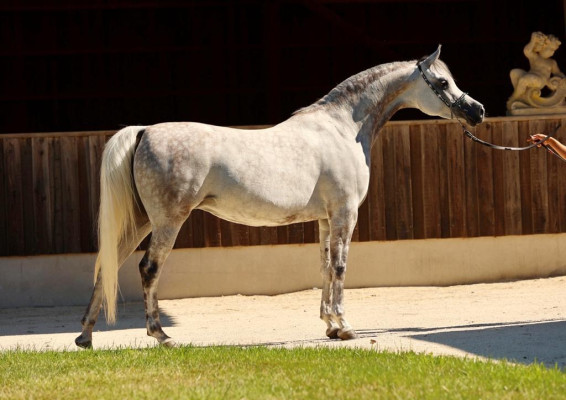
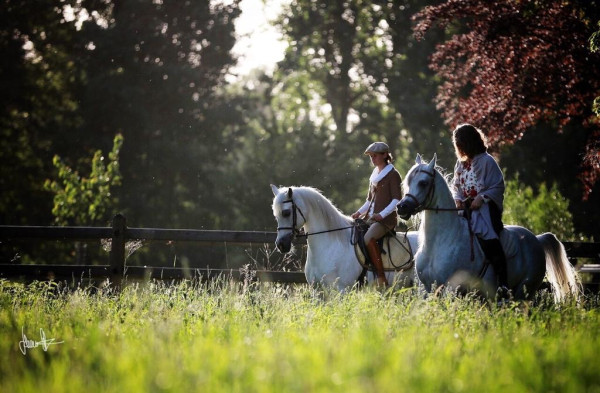
I raced through the house, and out into the garden, as far as the fence, which at that time limited my world. Opposite me, two riders were passing our house. One of them was mounted on a dapple-gray, a small, but powerful animal, playfully pawing the air with his fore legs as he danced over the road. His motions were effortless; his rider enjoyed them with reins slack and firm, but easy seat. Steed and rider were such a picture of grace and the hollow ring of the hooves was such music to my ears, that I have not forgotten it in my life. Nor have I forgotten the dark horse at his side, clumsily forging ahead —spiritless creature.
Suddenly my father stood next to me. Without a word, he lifted me to his shoulder and walked along parallel to the garden fence.
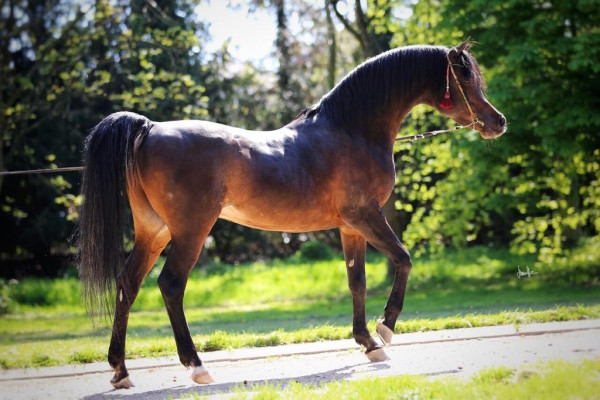
“This is an Arabian from Hungary,”father said. “The king has bought him for his royal stable.” I gazed after the Arabian Horse, from my father’s shoulders, until the animal disappeared under a big chestnut tree with pink candelabra of sweet blossoms.
I scrambled down his back; tears of chagrin filled my eyes. “Oh father!” I cried, “This horse is more beautiful than Phili.” My father smiled. “Yes he is. The Arabian is the king of all horses.”
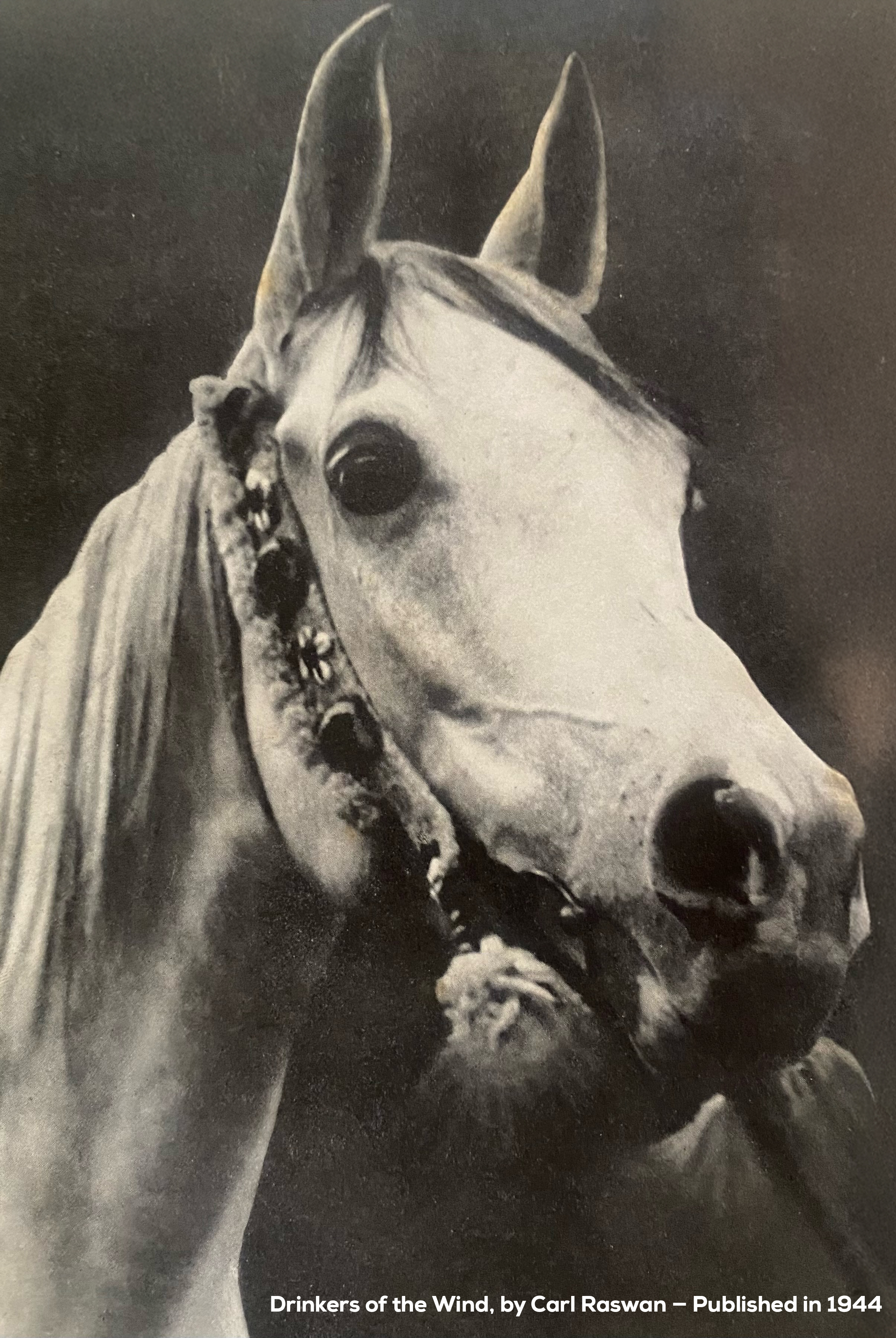
— Drinkers of the Wind, by Carl Raswan, 1944